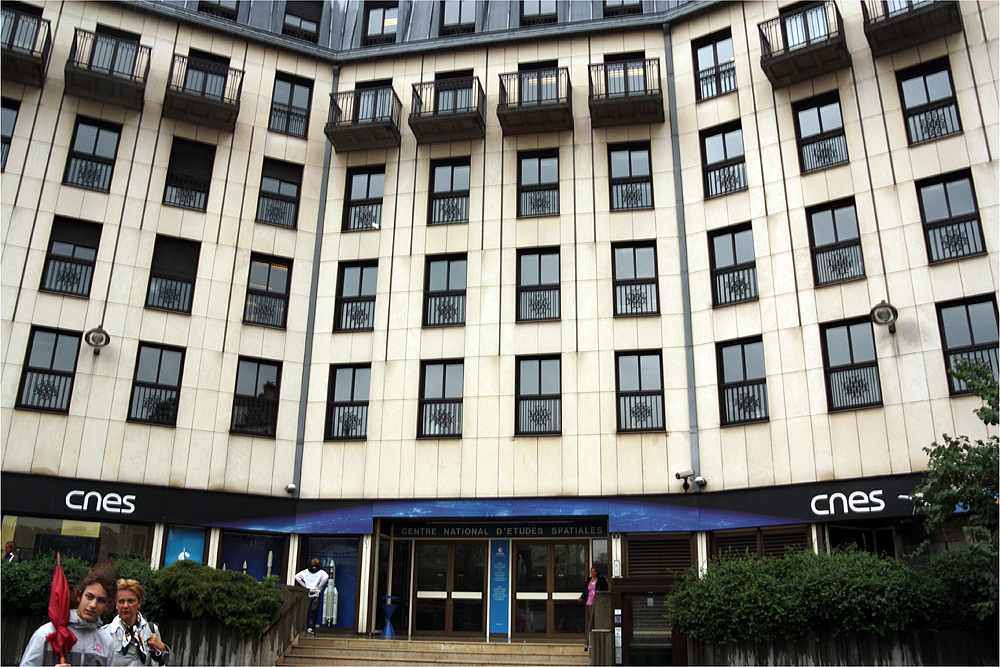
He has the discreet demeanor of senior civil servants, the measured tone of an engineer, and the pragmatism of an industrial leader. At 65, François Jacq has just been reappointed for an additional five years at the head of the Centre national d'études spatiales (CNES), by a decree from the Council of Ministers dated April 15, 2026, published in the Official Journal the following day. This reappointment, expected but not predetermined in a sector affected by political turbulence, makes him one of the most experienced French leaders in the scientific and industrial complex. It comes at a time when European space sovereignty has become a major geostrategic issue.
An exceptional career, shaped by rigor
Born in 1960 in Cherbourg, son of a naval construction engineer and a teacher, François Jacq embodies the archetype of the technical republican elite. A graduate of Polytechnique (X 1980), from the Mines corps, holder of a doctorate in theoretical physics from École polytechnique, and an ENA graduate (Léon-Blum promotion, 1989): his CV lists titles reserved for the top 0.01% of French youth. But what distinguishes him is less his academic background than his versatility. Successively Director of Industrial Affairs at the Ministry of Industry under Jospin, technical advisor to Lionel Stoléru at the Elysée Palace, President of Météo-France from 2009 to 2013, Chairman of Areva — which became Orano — from 2013 to 2018, and then Chairman and CEO of the Commissariat à l'énergie atomique (CEA) from 2018 to 2025, he has overseen four of the Republic's most strategic agencies.
Arrival at CNES in May 2025
He took over the leadership of CNES on May 23, 2025, succeeding Philippe Baptiste, who became Minister of Higher Education and Research in the Bayrou government. His appointment comes at a moment of doubt for the French space agency, in the midst of a dispute with ArianeGroup over the profitability of Ariane 6 and weakened by direct competition from SpaceX. "CNES is not an administration, it is an industrial player," he confided to La Tribune in June 2025. His first decision marked a turning point: centralizing technical decisions on Ariane 6 between Toulouse and the Parisian headquarters at Quai Branly, to the detriment of ArianeGroup's autonomy. A break from the doctrine in place for thirty years.
Ariane 6, the central industrial challenge
The number one challenge of his new mandate can be summed up in two words: Ariane 6. The European launcher, whose second flight was successful in March 2024 and which completed four commercial missions in 2025, must reach a cadence of 9 launches in 2026 and 12 in 2027 to remain economically viable. For comparison, SpaceX carried out 134 Falcon 9 launches in 2025. The cost of an Ariane 6 launch remains at 90 million euros, compared to 40 million for a reusable Falcon 9. In November 2025, François Jacq announced the launch of the Maïa program, the future European reusable launcher planned for 2030, with a budget of 4.3 billion euros — funded 60% by the European Space Agency and 40% by national contributions.
The IRIS² constellation accelerates
The second challenge is that of sovereignty in low Earth orbit. The European IRIS² program — Infrastructure for Resilience, Interconnectivity and Security by Satellite — aims to deploy 264 satellites by 2030 to provide sovereign encrypted connectivity to member states and strategic companies. In March 2026, François Jacq negotiated the doubling of France's contribution to this program, bringing it to 1.2 billion euros over five years. The first batch of 18 satellites is scheduled to launch at the end of 2026 from Kourou. This is the direct European response to Starlink — which currently has 7,800 satellites in orbit — and Amazon's future Project Kuiper.
A rare figure in France: the strategic engineer
What strikes his interlocutors is his ability to maintain a precise technical vision while making political and budgetary decisions. "François is neither a salesman selling dreams nor a pure scientist locked in his equations. He is a strategic engineer, a species that has become rare in France," commented Jean-Yves Le Gall, former president of CNES, in Les Échos. He does not give interviews to magazine press, refuses Forbes covers, and most often lunches in the Quai Branly canteen with his teams. Married to a CNRS biophysicist and father of three children, he has lived in the 14th arrondissement of Paris since 1995.
Editorial opinion
The reappointment of François Jacq at the head of CNES sends a strong political signal: Emmanuel Macron wants stability and competence at a time when France and Europe risk being outranked in the commercial space sector. Jacq's profile — discreet, technical, not very media-oriented but formidably effective in industrial decision-making — is exactly what is needed to manage Ariane 6, IRIS², and Maïa, three titanic projects with staggered horizons. The big question remains open: does France truly have the budgetary means for its space ambitions? In 2026, CNES has a budget of 2.5 billion euros — compared to nearly 25 billion for NASA and 12 billion for the China National Space Administration. Without a major strengthening of European solidarity, which will have to be fought for in the EU Council, François Jacq's talent will not be enough. His main battle over the next five years will be less technical than political. And there, paradoxically, the most discreet polytechnician in the Republic could well become one of the most decisive European strategists of the decade.
Key takeaways
- François Jacq reappointed for 5 years at the head of CNES by decree on April 15, 2026.
- Polytechnique graduate (X 1980), ENA graduate, doctorate in physics, former CEO of Areva (2013-2018) and CEA (2018-2025).
- Three priority projects: Ariane 6 (12 flights targeted in 2027), IRIS² (264 satellites by 2030), Maïa (reusable launcher 2030, €4.3 billion).
- CNES budget 2026: €2.5 billion, compared to $25 billion for NASA and $12 billion for CNSA (China).
- Rare "strategic engineer" profile praised by Jean-Yves Le Gall and the European space ecosystem.