
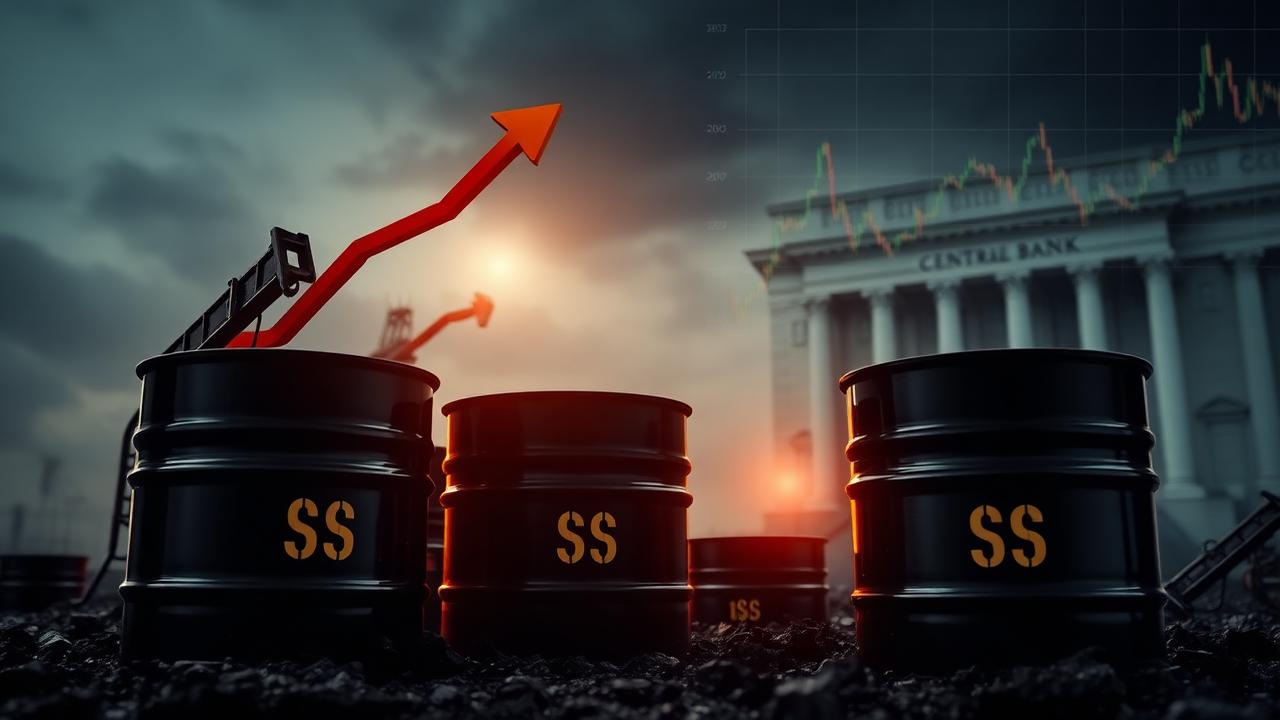
The Governor of the Bank of France sounded the alarm on April 3, 2026: the European economic situation is now "closer to the unfavorable intermediate scenario" than the "baseline scenario" considered in March by the European Central Bank (ECB). This statement, made in the midst of the Middle East war, reflects the growing concern of monetary authorities in the face of a prolonged oil shock.
"The prolongation of the conflict and the recurring closure of the Strait of Hormuz create unprecedented uncertainty since the 1970s," he added, calling for "the utmost vigilance."
The General Directorate of the Treasury, in its global spring 2026 outlook published on April 3, confirms the scale of the shock. The global economy is "severely affected by the Middle East conflict and the resulting new energy shock." The impact on growth will be "heterogeneous between countries depending on their intensity and energy mix." Countries most dependent on hydrocarbon imports - particularly in Africa, South Asia, and the Indian Ocean - are the most vulnerable. French Economy Minister Roland Lescure himself spoke of a "new oil shock" before the National Assembly on March 24, warning that "the assumption of a temporary crisis is unfortunately no longer valid."
The OECD, in its March 2026 Economic Outlook, emphasizes that the resilience of the global economy is "being tested." The new inflationary pressures generated by the rise in oil prices (which exceeded $120 a barrel before the ceasefire) are weighing on household consumption and corporate margins. In the euro area, headline inflation (HICP) would rise to an annual average of 1.7% in the Bank of France's baseline scenario, after 0.9% in 2025 - but this figure could be significantly higher if the conflict continues. The ECB, which had begun a rate-cutting cycle, finds itself in a delicate position: cutting rates to support growth risks fueling imported inflation.
For France, the shock is real but partially cushioned. The French energy mix, dominated by nuclear power (around 70% of electricity production), limits the direct impact on electricity prices. However, fuels and gas heating are directly affected. The fiscal surplus of 270 million euros recorded in March thanks to increased VAT revenue on fuels does not offset the macroeconomic cost of the crisis. The Bank of France has lowered its growth forecasts for 2026 and 2027, while ruling out a recession scenario - "for now."
Financial markets reflect this anxiety. The euro has weakened against the dollar, European bond yields have risen, and the most energy-intensive sectors (transport, chemicals, heavy industry) are significantly underperforming on the stock market. BNP Paribas, in its weekly update of April 7, notes that growth nowcasts are deteriorating rapidly. The central scenario remains one of a slowdown, not a recession - but with an exceptionally wide margin of uncertainty. As the Treasury Department summarizes: "Everything depends on the duration and intensity of the conflict."
Sources and links: - Direction générale du Trésor: https://www.tresor.economie.gouv.fr/Articles/2026/04/03/perspectives-mondiales-au-printemps-2026-l-economie-mondiale-a-l-epreuve-d-un-nouveau-choc-energetique - Banque de France (Projections): https://banque-france.fr/fr/publications-et-statistiques/publications/projections-macroeconomiques-intermediaires-mars-2026 - OECD: https://www.oecd.org/fr/about/news/press-releases/2026/03/global-economic-outlook-remains-robust-but-has-weakened-amid-energy-shock-and-geopolitical-risks.html - Challenges: https://www.challenges.fr/economie/guerre-au-moyen-orient-la-banque-de-france-revoit-ses-previsions-de-croissance-a-la-baisse-mais-ne-prevoit-pas-de-recession_642120 - Capital: https://www.capital.fr/economie-politique/nouveau-choc-petrolier-le-ministre-de-l-economie-alerte-sur-un-risque-pour-la-croissance-1524991 - BNP Paribas Research: http://economic-research.bnpparibas.com/html/fr-FR/scenario-nowcasts-previsions-Recherche-economique-7-avril-2026-07/04/2026,53207