
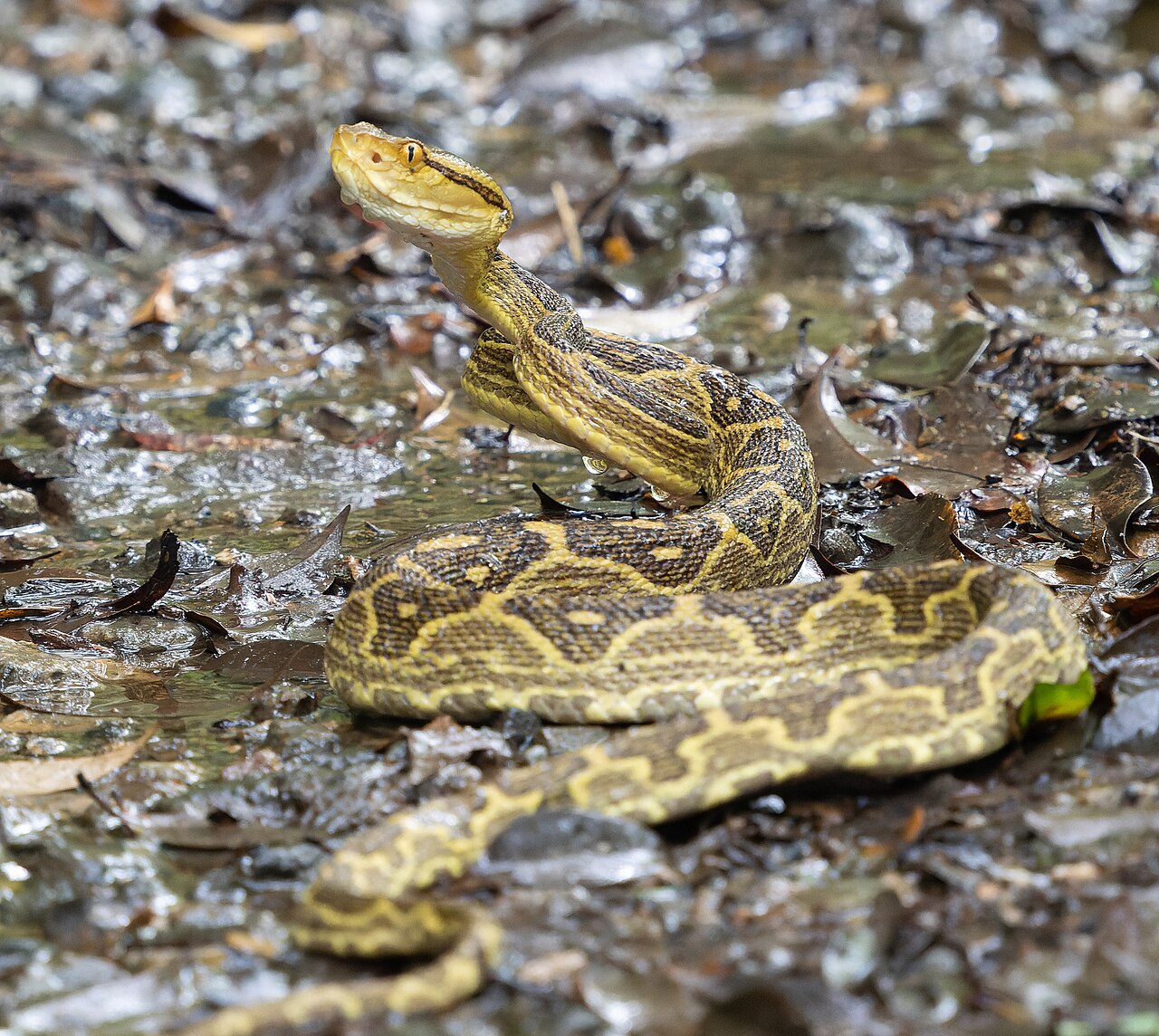
In the misty forests of southern Sichuan, at altitudes exceeding 1,800 meters, a team of herpetologists from Sun Yat-sen University in Guangzhou has identified a new pit viper species. Described in the scientific journal Zootaxa and reported by Le Figaro on April 24, 2026, the animal belongs to the Protobothrops genus, a group of pit vipers endemic to tropical Asia. Its glowing amber eyes, black-bordered dorsal scales, and arboreal habits make for a spectacular — and concerning — discovery, as researchers warn it "may pose a risk to populations" in high-altitude villages.
An Expanding Taxonomic Genus
The Protobothrops genus, established in 1983, originally comprised only seven described species until the 2000s. Since then, the advent of low-cost DNA sequencing and intensified herpetological expeditions in Southwest China have led to an explosion in numbers: there are now 18 species, with a majority described after 2010. The Sichuan pit viper joins famous relatives such as Protobothrops mangshanensis, one of the world's rarest venomous snakes, and Protobothrops flavoviridis, the formidable Okinawa habu, which still causes several dozen envenomations annually in Japan. All these snakes share a morphological trait: the "loreal pit," an infrared sensory organ located between the eye and nostril, enabling them to detect the body heat of their prey from several meters away.
Anatomy of a Discovery
During a field mission in the Wolong National Nature Reserve, renowned for its giant pandas, researchers collected the initial specimens. Morphological analysis revealed notable differences from neighboring species: a slightly higher number of ventral scales, specific cranial ornamentation, and, most significantly, an orange-amber iris coloration never before documented in Protobothrops. Sequencing of four mitochondrial markers and two nuclear genes confirmed the genetic isolation of the population, which is sufficiently ancient — approximately 2.3 million years old according to divergence models — to warrant the establishment of a distinct species. The scientific name, still pending validation by the International Commission on Zoological Nomenclature, is expected to honor the Sichuan region.
A Health Risk Not to Be Minimized
The venom of Protobothrops is a formidable hemotoxic cocktail, combining metalloproteinases that destroy blood vessels with phospholipases that cause severe coagulopathy. Bites, without antivenin, can lead to necrosis, internal hemorrhaging, and kidney failure. Chinese health authorities have announced the launch of a comparative toxicology study within the next six months to determine if the currently used Chinese polyspecific antivenin is effective against the new venom, or if a specific serum will need to be developed. In the meantime, Sichuan villagers are advised to avoid damp wooded areas at dusk, the snake's peak activity period. No fatal envenomations have been linked to the new species thus far, but its proximity to rural dwellings is a cause for concern.
China: A Hotspot of Snake Biodiversity
This discovery is not an isolated event. Since 2015, Southwest China – Yunnan, Sichuan, Guizhou – has seen the description of over 30 new snake species, making it one of the three main global centers of taxonomic innovation in herpetology, alongside the Amazon and Southeast Asia. This richness is attributed to a combination of highly fragmented karst topography, which promotes genetic isolation of populations, a subtropical humid climate, and a long evolutionary history without major glaciation. The downside: many of these newly described species are already threatened by deforestation, urbanization, and the illegal exotic pet trade. Several Protobothrops species are now listed on the IUCN Red List in categories ranging from "Vulnerable" to "Critically Endangered."
Editorial Opinion
The discovery of the amber-eyed Sichuan pit viper is, in many ways, good news. It reminds us that nature still holds countless secrets, even in the 21st century, and even within a group of animals as studied as vipers. It also confirms the growing quality of Chinese herpetological research, which now stands proudly alongside its American, Australian, or European counterparts. However, this discovery is also a warning: as China industrializes its western regions and deforests for intensive agriculture or hydroelectric dams, a unique genetic heritage is disappearing. Many species described today could vanish tomorrow, without us even having studied their ecology or the molecules in their venom — molecules known to inspire new cardiovascular or anticoagulant drugs. Protecting Sichuan's forests is not just about defending giant pandas; it's also about saving snakes we are only just beginning to know. Snake biodiversity, often unloved, deserves the same attention as charismatic megafauna.
Key Takeaways
- New pit viper species of the genus Protobothrops described in April 2026.
- Habitat: mountainous forests of Sichuan (China), above 1,800 m.
- Distinctive features: orange-amber iris, black-bordered dorsal scales.
- Protobothrops genus: 18 described species, half described since 2010.
- Potentially dangerous hemotoxic venom; specific antivenin under study.